

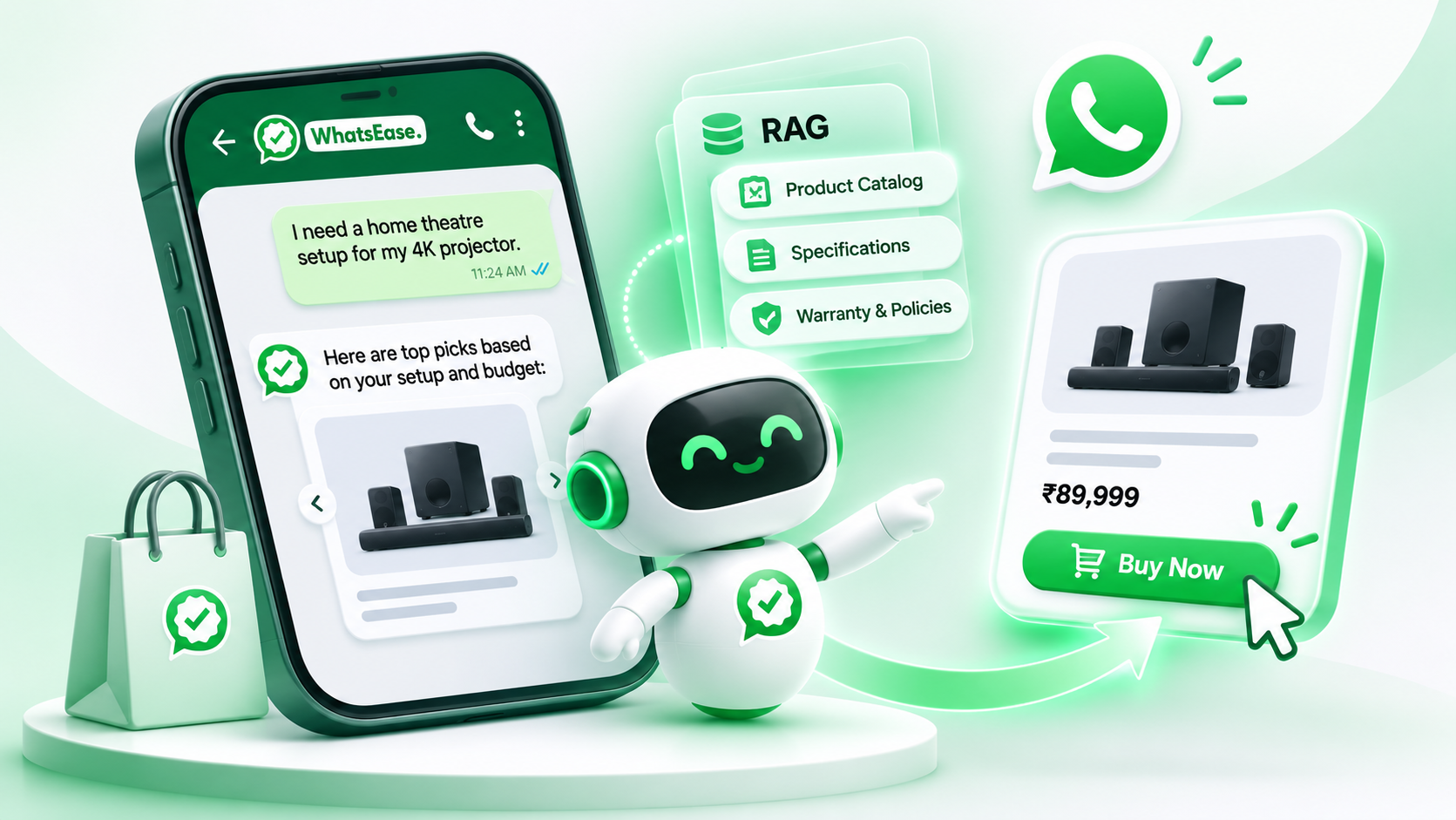
What if customers could research a product, get personalized recommendations, ask detailed questions and complete a high-value purchase without leaving WhatsApp? That's the next evolution of conversational commerce.
Selling a ₹500 product through a message is relatively simple. Selling a ₹50,000 product is different.
Customers want detailed information, comparisons, recommendations and reassurance before making a decision. They might ask ten questions, request product specifications or want to speak with an expert.
Traditional ecommerce sends them through product pages and checkout forms. But in 2026, businesses are increasingly exploring a different approach: AI-powered conversational commerce.
Why High-Ticket Sales Need More Than a Chatbot
High-ticket purchases involve more consideration than everyday transactions.
Think about someone purchasing premium electronics, furniture, jewellery or a business service.
They might ask:
- Which product is best for my requirements?
- How does this compare with another model?
- Is this suitable for my specific use case?
- What are the payment options?
- Can I get additional information before purchasing?
A traditional chatbot usually follows predefined questions and answers.
But high-value customers need conversations that understand context, retrieve accurate information and guide purchasing decisions.
This is where Retrieval-Augmented Generation (RAG) becomes interesting.
What Is RAG and Why Does It Matter for Conversational Commerce?
RAG stands for Retrieval-Augmented Generation.
It is an AI architecture that allows a language model to retrieve relevant information from external knowledge sources before generating a response.
Instead of relying only on information learned during training, an AI assistant can reference business-specific information such as:
- Product catalogues
- Pricing and specifications
- Product documentation
- Frequently asked questions
- Policies and warranty information
- Previous customer interactions, where appropriately available
For example:
Customer: Is this laptop suitable for video editing?
AI Assistant: Based on its specifications, this model includes 32GB RAM and a dedicated graphics card, making it suitable for demanding editing workflows.
The AI can retrieve relevant product information before responding.
This makes conversations more contextual and useful, provided the underlying information is accurate and up to date.
From Product Discovery to Purchase: The New Sales Journey
Imagine a customer interested in purchasing a premium home theatre system.
Here's how an AI-powered conversational shopping experience could work:
1. Discovery: The customer messages your business and describes their requirements.
2. Understanding: The AI identifies their budget, room size and preferred features.
3. Recommendation: It retrieves relevant product information and suggests suitable options.
4. Comparison: The customer compares specifications, pricing and features through the conversation.
5. Assistance: The AI answers questions using verified business information and escalates complex queries to a sales representative when necessary.
6. Checkout: Once the customer is ready, the business provides a direct checkout or supported payment experience.
The customer doesn't have to navigate multiple pages just to get answers.
The conversation becomes part of the buying journey.
Why Direct Checkout Changes Everything
Getting a customer interested is only half the job.
The next challenge is converting that interest into an actual purchase.
Redirecting customers between messaging applications, product pages and payment gateways can introduce friction.
Direct checkout experiences can simplify this transition.
For example, WhatsApp Flows can provide interactive in-chat forms for collecting customer information and supporting checkout journeys. Payment integrations can then help businesses collect payments through supported payment experiences.
For ecommerce businesses, integrations with platforms such as Shopify can also connect conversational shopping with actual order management.
The objective is simple:
Discover → Understand → Recommend → Purchase.
Fewer unnecessary steps between customer intent and transaction completion.
What Businesses Need to Build Conversational Commerce
A successful conversational commerce setup requires more than connecting an AI model to WhatsApp.
Businesses should consider five important components:
- AI chatbot: Understand customer questions and maintain conversational context.
- RAG knowledge base: Retrieve accurate product information, specifications and policies.
- Product catalogue: Make relevant products and variants discoverable.
- CRM and automation: Manage leads, conversations, follow-ups and human handovers.
- Checkout and payments: Connect customer intent with supported ordering and payment workflows.
These components work together to create a connected sales experience.
Where WhatsEase Fits In
WhatsEase focuses on helping businesses manage customer conversations and conversational commerce through WhatsApp.
Its capabilities include:
- WhatsApp CRM and Universal Inbox
- AI-powered customer conversations
- Automation workflows
- Lead management
- Shopify integration
- WhatsApp Flows-based shopping experiences
- Payment collection capabilities
Together, these capabilities help businesses connect customer engagement with sales and commerce operations.
For businesses exploring more advanced AI architectures, RAG can also be an important consideration when building assistants that need to answer detailed, business-specific product questions.
The Future of Selling Is Conversational
In 2026, the opportunity isn't simply to put an AI chatbot on every website.
It's to rethink how customers discover products, evaluate options and make purchasing decisions.
For high-ticket businesses, this is particularly important. Customers need information, confidence and assistance before committing to a purchase.
RAG helps make AI conversations more grounded in business knowledge. Direct checkout helps reduce friction when customers are ready to buy. CRM and automation help businesses manage the relationship beyond a single transaction.
The next generation of ecommerce won't just be about bringing customers to your store. It will be about bringing your store, expertise and checkout into the conversations customers are already having.
Explore WhatsEase to build smarter WhatsApp customer experiences.
About WhatsEase
WhatsEase is a WhatsApp conversational commerce and CRM platform that helps businesses manage customer conversations, automate workflows, capture leads, sell products, collect payments and scale customer engagement on WhatsApp.