
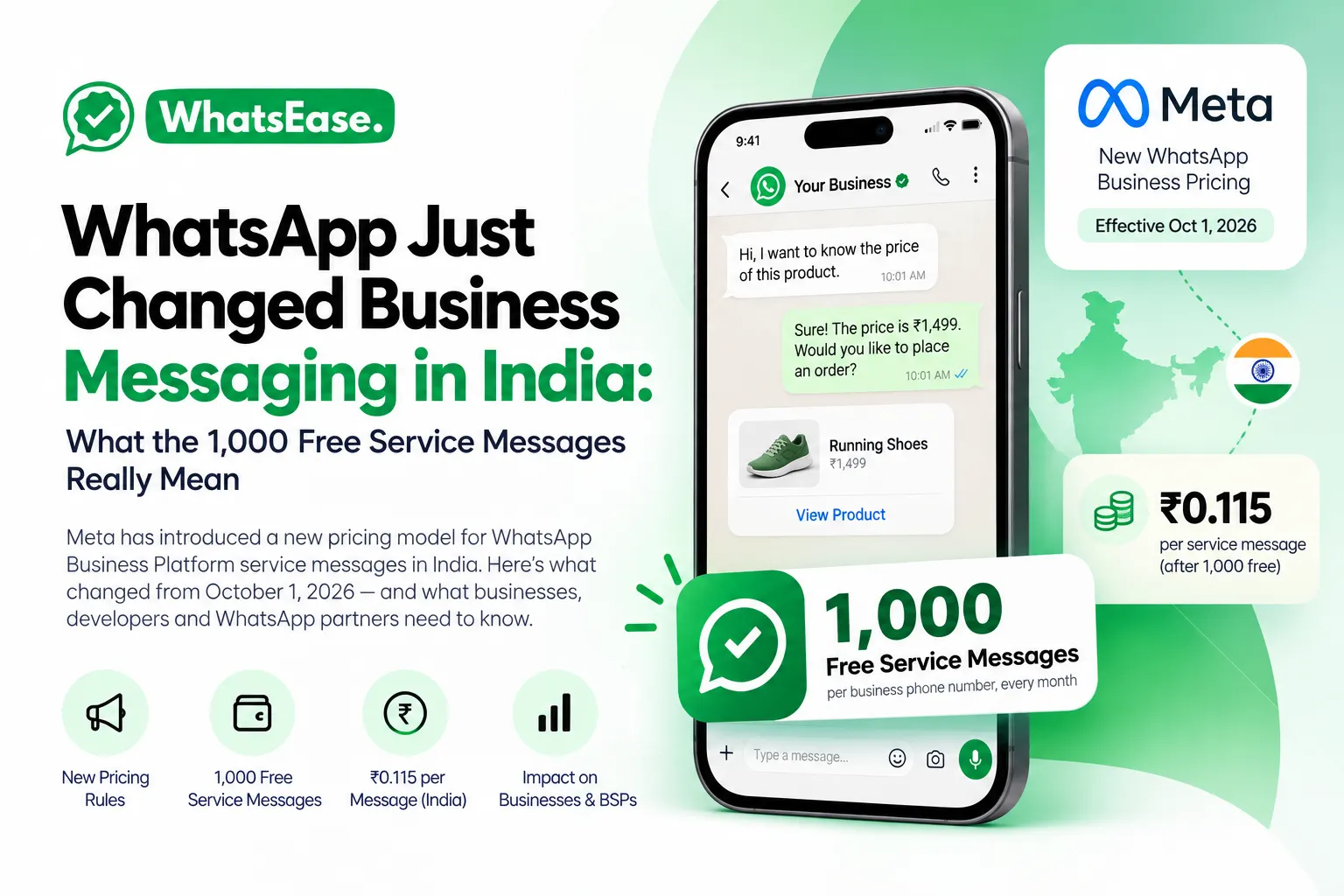
Meta has introduced a new pricing model for WhatsApp Business Platform service messages in India. Here’s what changed from October 1, 2026 — and what businesses, developers and WhatsApp Solution Providers need to know.
If your business uses WhatsApp for customer support, lead qualification, order updates, automation or AI-powered conversations, there is an important pricing change you need to understand.
Starting October 1, 2026, Meta began charging for WhatsApp service messages.
But there is a significant free allowance:
Every business phone number gets 1,000 free service messages every month.
Once those 1,000 messages are used, additional service messages are charged according to Meta’s applicable rate for the recipient’s market.
For businesses in India, the service-message rate is currently ₹0.115 per delivered message after the monthly free allowance.
This change affects businesses using the WhatsApp Business Platform directly as well as businesses accessing WhatsApp through Solution Providers and other Meta partners.
So what exactly changed?
Let’s break it down.
What Are WhatsApp Service Messages?
Service messages are messages businesses send in response to a customer’s interaction with the business.
Think of situations such as:
- A customer asks a question on WhatsApp.
- A customer wants help with an order.
- A customer requests information.
- A customer is speaking to a support agent.
- An AI chatbot responds to a customer.
- A business representative continues a customer conversation.
These are different from proactive marketing messages such as promotional campaigns, offers and advertisements.
The distinction matters because Meta’s WhatsApp Business Platform pricing is now based on the type of message being delivered.
What Changed on October 1, 2026?
Before October 1, service messaging inside the customer-service conversation flow was treated differently from Meta’s paid message categories.
From October 1, 2026, Meta introduced a monthly free allowance for service messages:
1,000 service messages per business phone number, every month.
After the first 1,000 delivered service messages, additional service messages become chargeable.
For India, the applicable service-message rate is currently ₹0.115 per delivered message.
The free allowance is therefore best understood as a monthly service-message quota, rather than 1,000 free conversations.
1,000 Free Messages ≠ 1,000 Free Conversations
This is probably the most important distinction businesses need to understand.
Meta is giving businesses:
1,000 free service messages
—not—
1,000 free conversations.
A single WhatsApp conversation can contain many messages.
For example:
Customer:
"Hi, I want to know the price."
Business:
"Sure. Which product are you interested in?"
Customer:
"The blue one."
Business:
"The blue variant is ₹1,499."
Customer:
"Do you have COD?"
That can already represent multiple service-message deliveries from the business.
Therefore, businesses that have thousands of customer conversations should not assume that the new allowance covers 1,000 conversations.
The relevant measurement is delivered service messages.
How Much Does WhatsApp Service Messaging Cost in India?
For Indian recipients, the current Meta service-message rate is:
| WhatsApp message type | India rate |
|---|---|
| Service message | ₹0.115 after 1,000 free messages |
| Utility message | ₹0.115 |
| Authentication message | ₹0.115 |
| Marketing message | ₹0.8631 |
These are Meta’s message-delivery charges and should not automatically be treated as the final price a business pays to its WhatsApp platform provider.
A WhatsApp Solution Provider or software platform may have its own:
- Platform subscription
- Setup fees
- Automation fees
- Inbox/CRM fees
- AI usage charges
- Additional messaging markup
- Other value-added service charges
This distinction is important when comparing WhatsApp API providers.
Who Is Affected by the Change?
The change primarily matters to businesses using the WhatsApp Business Platform.
That includes businesses using WhatsApp through:
Direct Meta Integration
Businesses that integrate directly with the WhatsApp Business Platform are responsible for their Meta messaging charges.
WhatsApp Solution Providers
Businesses using a Solution Provider generally have their WhatsApp usage billed through the provider.
The provider may then charge additional fees for the software, infrastructure or services it provides.
WhatsApp CRM and Automation Platforms
Businesses using WhatsApp CRM, chatbot, automation and conversational-commerce platforms can also be affected because the underlying Meta messaging cost still exists.
In other words:
Changing your WhatsApp software provider does not eliminate Meta’s message-delivery charges.
The provider can structure its own pricing differently, but Meta’s underlying messaging rates remain part of the ecosystem.
Why Did Meta Introduce the 1,000 Free Service Message Allowance?
Meta describes the free allowance as a way to help businesses maintain an always-on channel for customer communication.
That makes sense particularly for smaller businesses.
Consider a business receiving a few hundred customer questions every month.
Under the new structure, it can handle up to 1,000 service-message deliveries per phone number each month without a Meta service-message charge.
For businesses with much higher messaging volumes, the calculation changes.
This means WhatsApp businesses should start looking at message volume, not simply the number of customers or conversations.
What About the 24-Hour Customer Service Window?
The 24-hour customer-service window remains an important concept in WhatsApp Business messaging.
However, businesses should no longer assume that keeping a conversation inside the service window automatically makes every business-generated message free.
The October 2026 pricing changes also affect how utility messages sent during an active customer-service window are treated.
This is an important change for businesses that previously designed their messaging workflows around the assumption that an open service window meant certain messages could be sent without a Meta charge.
The result is a much more granular pricing environment:
Customer interaction → message category → delivered message → applicable rate
Rather than simply:
Customer interaction → free 24-hour window
What Has NOT Become Paid?
There is an important distinction between messages sent by businesses and messages sent by customers.
The customer initiating a conversation with a business does not itself become a paid Meta message simply because the business is using WhatsApp Business Platform.
The pricing change is focused on business-side message delivery.
This is why WhatsApp can still function as a powerful inbound customer-service and sales channel.
The bigger question for businesses is how efficiently they respond once the customer enters the conversation.
What Does This Mean for WhatsApp AI Chatbots?
This is where the change becomes particularly interesting.
Imagine an AI chatbot handling customer conversations for an ecommerce business.
A customer asks:
"Where is my order?"
The AI checks the order system and responds.
Another customer asks:
"Do you have this product in size L?"
The AI checks the catalogue and responds.
Another asks:
"Can I change my delivery address?"
The AI handles the request.
Every business-generated response can contribute to the business’s service-message volume.
So businesses deploying AI on WhatsApp should start tracking:
- Service messages per phone number
- Messages per conversation
- Average messages per customer
- AI-generated messages
- Human-agent messages
- Resolution rate
- Automated resolution rate
- Cost per resolved conversation
This is where AI efficiency becomes a messaging-cost consideration, not just a productivity consideration.
What Does This Mean for WhatsApp CRM Platforms?
For WhatsApp CRM platforms, the change makes message-level analytics increasingly important.
A modern WhatsApp CRM should ideally help businesses understand:
How many service messages are being used?
Not just how many conversations are active.
Which workflows consume the most messages?
For example:
- Lead qualification
- Customer support
- Order tracking
- Payment reminders
- Product enquiries
- Appointment management
How much automation is actually useful?
More automation does not automatically mean better economics.
A workflow that sends five messages to accomplish something that could be completed in two should be examined.
Which conversations should be handed over to humans?
AI should ideally resolve straightforward requests while escalating complex conversations when necessary.
What Should Indian Businesses Do Now?
The October 2026 change doesn’t mean businesses should stop using WhatsApp.
Instead, it makes WhatsApp messaging efficiency more important.
Here are five things businesses should start doing.
1. Track Service-Message Consumption
Don’t look only at monthly conversation count.
Track the number of actual business-generated service messages.
2. Identify Repetitive Workflows
Look for workflows where customers and businesses exchange unnecessary messages.
For example:
Old workflow
Customer → Business → AI → Business → Customer → Business → Customer
Could potentially become:
Improved workflow
Customer → AI → Customer
The objective is not to reduce useful communication.
It is to eliminate unnecessary communication.
3. Separate Marketing, Utility and Service Use Cases
Different message categories have different pricing rules.
Your WhatsApp strategy should therefore be designed around the correct message category from the beginning.
4. Monitor Your Phone Numbers Separately
The free service-message allowance is provided per business phone number.
Businesses operating multiple numbers should therefore understand how messaging volume is distributed across those numbers.
5. Compare Total Platform Cost, Not Just Subscription Price
When comparing WhatsApp CRM or BSP providers, don’t look only at:
"₹X per month"
Look at:
Platform fee + Meta messaging charges + provider fees + AI costs + automation costs
That is much closer to the actual cost of operating WhatsApp at scale.
What Does This Mean for Meta Partners and WhatsApp Solution Providers?
The change is equally relevant to the ecosystem around WhatsApp.
Solution Providers, BSPs, CRM platforms and automation companies now have to communicate the new pricing structure clearly to their customers.
There are effectively two layers of economics:
Layer 1 — Meta
Meta determines the underlying WhatsApp Business Platform messaging charges.
Layer 2 — Partner
The Solution Provider or platform can charge for its own software, infrastructure and value-added services.
This means providers need to be transparent about the difference between:
- Meta charges
- Platform charges
For customers, this distinction will become increasingly important as WhatsApp becomes a larger part of their sales and support infrastructure.
A Simple Example
Suppose an Indian business phone number delivers:
2,500 service messages in one month.
The first:
1,000 messages → Free
Remaining:
1,500 messages → Chargeable
At ₹0.115 per delivered service message:
1,500 × ₹0.115 = ₹172.50
So the Meta service-message charge for those additional messages would be:
₹172.50
Before any applicable taxes or separate platform/provider fees.
Now consider a business delivering:
50,000 service messages.
The first 1,000 are covered.
That leaves:
49,000 chargeable messages.
At ₹0.115:
49,000 × ₹0.115 = ₹5,635
This is why message-volume tracking becomes increasingly important as businesses scale.
The Bigger Shift: From Conversations to Message Economics
The most interesting part of Meta’s pricing evolution isn’t simply the ₹0.115 charge.
It is the gradual shift from thinking about WhatsApp in terms of conversations to thinking about message delivery economics.
Businesses now need to understand:
- Who initiated the conversation?
- What type of message are we sending?
- How many messages are we delivering?
- How many messages does each workflow require?
- How much revenue or customer value does that workflow generate?
This changes how WhatsApp automation should be designed.
The goal should not simply be:
"Automate everything."
It should be:
"Automate the right things with the fewest unnecessary interactions."
What This Means for WhatsEase
For businesses using WhatsApp as a sales, support or commerce channel, this is exactly where a CRM and automation layer becomes useful.
WhatsEase brings together:
- WhatsApp CRM
- Universal Inbox
- Team management
- Lead management
- Bulk campaigns
- Automation flows
- AI-powered conversations
- Payment collection
- Ecommerce workflows
- Shopify integration
- WhatsApp catalogues
- Lead capture
- Analytics
As Meta’s pricing becomes more granular, businesses need visibility into not just who they are talking to, but also how their WhatsApp workflows are performing.
The next generation of WhatsApp commerce will therefore be less about sending more messages and more about creating smarter conversations.
Frequently Asked Questions
Are the first 1,000 WhatsApp service messages free?
Yes. Starting October 1, 2026, Meta provides the first 1,000 service messages per business phone number each month free of Meta service-message charges.
Is the 1,000-message allowance per WhatsApp Business Account?
The allowance is specified by Meta per business phone number.
What happens after 1,000 service messages?
Additional delivered service messages are charged at the applicable service-message rate for the recipient’s market.
For India, the current rate is ₹0.115 per delivered service message.
Does this affect normal WhatsApp users?
No. This pricing change concerns the WhatsApp Business Platform, not ordinary personal WhatsApp messaging.
Do WhatsApp Solution Providers also get the 1,000 free messages?
The Meta allowance applies to the business phone number using the WhatsApp Business Platform. Businesses working through Solution Providers should check how their provider presents Meta’s charges and any additional platform fees.
Are customer messages charged?
Meta’s messaging charges are applied to messages delivered by businesses. Customer-initiated messages themselves are not charged as business message deliveries.
Does WhatsApp API pricing now depend on message volume?
Yes. Meta’s current WhatsApp Business Platform pricing is based on delivered messages and message categories, with rates varying by market.
The Bottom Line
The 1,000 free service messages introduced in October 2026 are not simply a new WhatsApp discount.
They are part of a broader evolution in how Meta monetizes the WhatsApp Business Platform.
For Indian businesses, the practical takeaway is straightforward:
Track messages, not just conversations.
Understand message categories.
Measure automation efficiency.
Separate Meta charges from platform fees.
And most importantly:
Build WhatsApp workflows that resolve customer needs with fewer unnecessary messages — without sacrificing the quality of the conversation.
WhatsApp is becoming a more sophisticated business infrastructure layer.
The businesses that treat it like one will have a much clearer view of what their WhatsApp operations actually cost — and what they generate in return.
About WhatsEase
WhatsEase is a WhatsApp conversational commerce and CRM platform built to help businesses manage customer conversations, automate workflows, capture leads, sell products, collect payments and scale customer engagement on WhatsApp.